

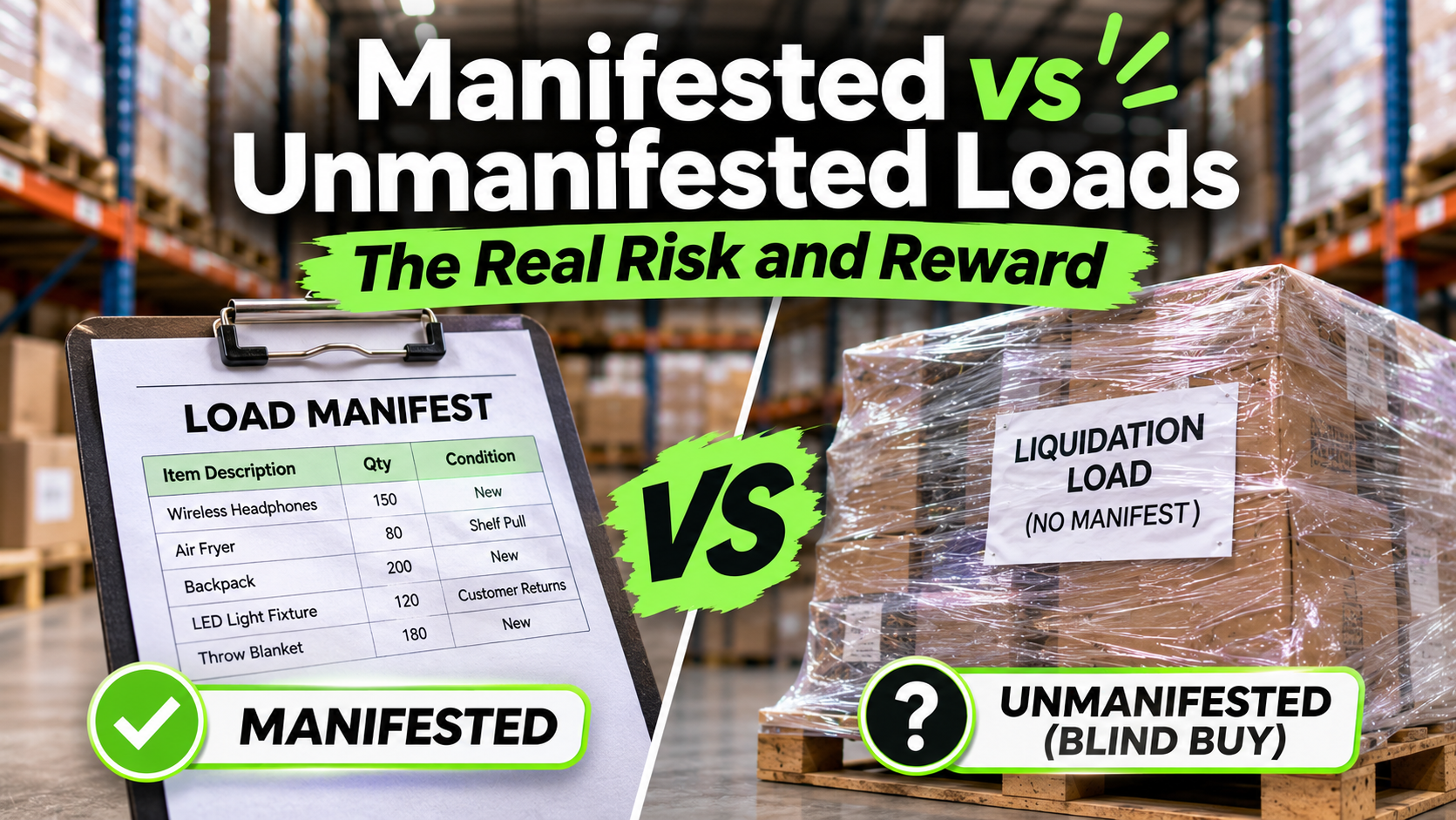
What you trade off when you buy a load with a manifest versus a blind buy, and how to decide which one fits where your business is right now.
Every buyer in this industry eventually has to decide how much certainty they need before they're willing to spend money. Manifested and unmanifested loads sit on opposite ends of that decision, and neither one is automatically the right choice. Understanding what you're actually trading off between the two, information for potential upside, is what separates buyers who use each type strategically from buyers who get burned by picking the wrong one at the wrong time.
THE DEFINITIONS
What Manifested and Unmanifested Actually Mean
A manifested load comes with a detailed list of what's inside, typically including item descriptions, quantities, condition, and often the original retail value of each line item. You know largely what you're buying before it ever arrives.
An unmanifested load, sometimes called a blind buy, comes with little to no itemized information. You might know the general category, general condition, and total unit count, but the specific contents remain a mystery until the load is opened and sorted.
THE CASE FOR MANIFESTED
Why Manifested Loads Are the Safer Starting Point
Manifested loads let you research resale value before you commit any money, which removes a huge amount of guesswork from the purchase. You can check what similar items are actually selling for, estimate a realistic recovery rate, and walk into the deal with numbers instead of hope. This predictability comes at a cost though, manifested loads are typically priced higher per unit than unmanifested ones, since the seller is providing more value in the form of information and the buyer is taking on less risk.
For newer buyers, or for anyone working with a smaller budget that can't absorb a disappointing load, manifested inventory is almost always the more responsible place to start. It gives you the chance to learn how a category performs in the real world without also gambling on what's actually in the box.
THE CASE FOR UNMANIFESTED
Why Experienced Buyers Still Chase Blind Buys
Unmanifested loads exist because the lack of information cuts both ways. Sellers price them lower precisely because nobody, including the seller in many cases, knows exactly what's inside. That pricing gap is where the upside lives. Experienced buyers who understand a category well can sometimes recover far more value from an unmanifested load than the purchase price would suggest, simply because the market hasn't priced in the specific contents.
This works because experienced buyers have something newer buyers usually don't yet, a track record with a category that lets them make an educated guess about what a load probably contains, even without a manifest. They've bought enough similar loads to know the rough odds, and they've built enough capital cushion to absorb the occasional load that underperforms without it threatening the business.
THE REAL RISK
What the Risk Actually Looks Like in Practice
The risk in an unmanifested load isn't usually total loss. It's more often a mismatch between expectation and reality, more low value units than anticipated, a category mix that doesn't match your sales channels, or a higher percentage of damaged product than a similar manifested load would carry. That risk is manageable for a buyer with the cash flow to absorb a below average load and the patience to sort through what actually arrives. It's much harder to manage for a buyer who needs every single purchase to perform in order to stay afloat.
HOW TO DECIDE
Matching the Load Type to Where You Actually Are
The right choice usually comes down to three honest questions. Can your budget absorb a load that underperforms without putting the business at risk. Do you understand this specific category well enough to estimate what an unmanifested load is likely to contain. Do you have the sales channels and time to sort and move a less predictable mix of inventory. If the answer to all three is yes, unmanifested loads can genuinely outperform manifested ones on return. If the answer to any of them is no, the safer, more predictable path of manifested inventory is usually the better move until that changes.
